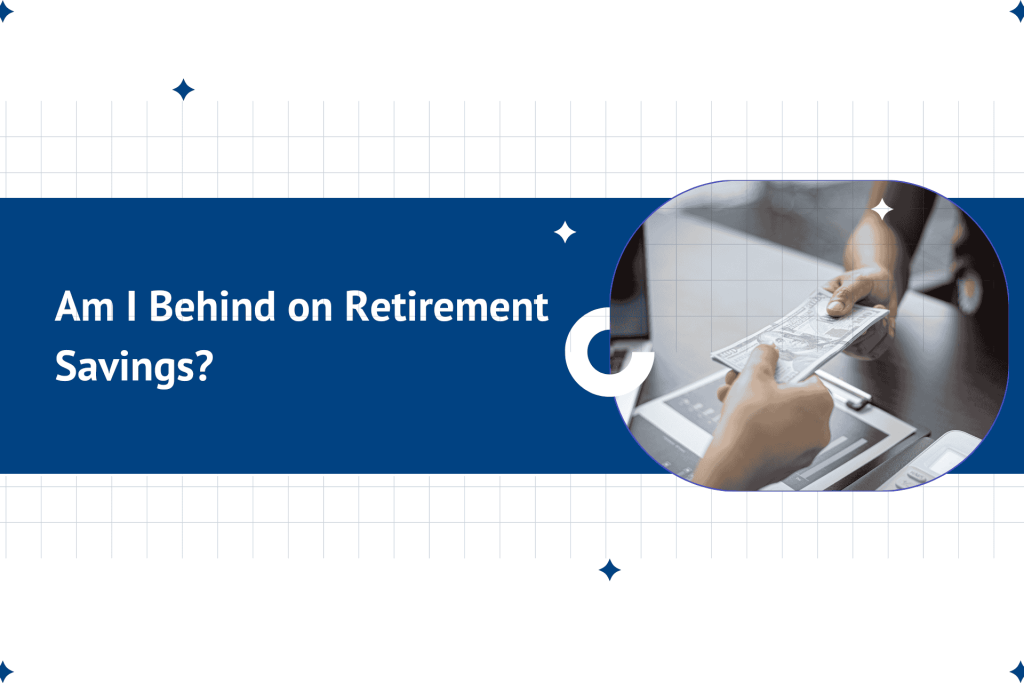
Am I Behind on
Retirement Savings?
Most self-employed professionals are behind — by a lot. But there is a legal tool that lets you contribute $150,000–$275,000 per year to close the gap. Here is the honest truth, by age.
If you filed your taxes this week and felt a quiet panic when you looked at your retirement account balance — you are not alone. The average American aged 55–64 has about $95,000 saved. Fidelity says someone earning $80,000 should have $640,000 by age 60. That gap is not a minor shortfall. It is a retirement crisis playing out silently in millions of households. But for self-employed professionals, the story does not have to end there.
This article will show you exactly where you should be by age, how far the average person actually is, and — most importantly — the one retirement vehicle that turns "behind" into "caught up" faster than anything else legally available to self-employed people in 2026.
The Honest Benchmarks: Where Should You Be?
The most widely used retirement benchmarks come from Fidelity Investments, whose research suggests you should have saved a multiple of your annual income by certain ages to retire comfortably at 67. These are not arbitrary numbers — they are built on decades of consumer spending data and the assumption that you will need to replace roughly 45% of your pre-retirement income from your own savings (with Social Security covering the rest).
| Age | Fidelity Benchmark (×salary) | Target if earning $200K | Avg. actually saved (Fed Reserve) | Typical gap |
|---|---|---|---|---|
| 40 | 3× salary | $600,000 | $141,520 | −$458,480 |
| 45 | 4× salary | $800,000 | ~$200,000* | −$600,000 |
| 50 | 6× salary | $1,200,000 | $313,220 | −$886,780 |
| 55 | 7× salary | $1,400,000 | $95,642** | −$1,304,358 |
| 60 | 8× salary | $1,600,000 | $537,560 | −$1,062,440 |
| 67 | 10× salary | $2,000,000 | $609,230 | −$1,390,770 |
| DB Plan: Max annual contribution | $100K–$275K/yr | Can close a $1M+ gap within 5–10 years | ||
*Estimated interpolation. **Median 401(k) balance for ages 55–64 per Vanguard's 2025 "How America Saves" report. Benchmarks source: Fidelity Investments. Federal Reserve Survey of Consumer Finances 2022.
A 60-year-old earning $80,000 should have approximately $640,000 saved per Fidelity's guidelines. The typical person that age has less than $100,000. That means tens of millions of Americans face a retirement shortfall that a standard 401(k) — capped at $72,000 per year — cannot realistically fix in the time they have left.
Why Self-Employed Professionals Fall Further Behind
If you have been self-employed for a significant part of your career, there is a good chance your retirement savings gap is even wider than the averages above. Several forces work against independent workers that salaried employees do not face:
-
✗No employer match. W-2 employees in many companies receive 3–6% of their salary in matching contributions automatically. Self-employed professionals receive nothing unless they set up their own plan and fund it themselves.
-
✗Inconsistent saving in early years. The first years of self-employment often mean variable income, tight cash flow, and retirement contributions that get skipped. Those are exactly the years that compound interest most rewards.
-
✗Self-employment tax eats first. Self-employed professionals pay 15.3% self-employment tax on top of income tax. After SE tax, ordinary expenses, and estimated quarterly payments, retirement saving often falls to the bottom of the list.
-
✗Business investment bias. Many business owners reinvest cash back into their practice or company instead of into retirement accounts. The business becomes their implicit retirement plan — a strategy that collapses if the business cannot be sold for what they hoped.
-
✓But the tax code compensates generously. The flip side of all this: the IRS gives self-employed professionals access to retirement plans that are dramatically more powerful than anything available to standard W-2 employees. You can leverage this now.
The Savings Gap Visualised: What Average vs. What's Needed
The chart below illustrates the gap between what the average person has saved, what Fidelity says they should have (assuming a $200,000 income), and what is achievable by adding a Defined Benefit Plan contribution over 10 years on top of existing savings.
Projections are illustrative only and assume a 5% annual investment return within the plan. DB contribution figures are estimates; actual amounts require actuarial certification.
The Catch-Up Tool Most Self-Employed Professionals Don't Know About
Here is the part that changes the conversation. While most people know about the standard catch-up contribution rules — an extra $8,000 to a 401(k) if you are over 50, or an extra $1,100 to an IRA — these amounts are barely meaningful when you are facing a $500,000–$1,000,000+ savings gap.
The tool that actually moves the needle is a Defined Benefit Plan. Unlike contribution-capped plans, a DB plan is funded to meet a target retirement benefit — and the older you are when you start, the larger the required annual contribution because you have less time to accumulate the benefit. This is the rare case in retirement planning where being older and having started late is actually an advantage.
- Solo 401(k): $72,000 ceiling regardless of income
- IRA catch-up: $8,600 (age 50+)
- At 37% tax bracket, max savings: ~$30K tax relief
- To close a $900K gap over 10 years: mathematically impossible
- Good for: under 45, lower income, simple setup
- Contribution increases with age — starts later = contributes more
- Deductible amounts: $100K–$275K+ annually
- Tax savings at 37%: $37K–$102K per year
- To close a $900K gap over 10 years: achievable
- Can pair with Safe Harbor 401(k) for even more
*$80,500 = $72,000 Solo 401(k) + $8,600 IRA for ages 50+, 2026. **DB contributions are actuarially determined and vary by age, income, and target retirement date.
"A 58-year-old physician who starts a Defined Benefit Plan today has only 7 years to fund her retirement benefit — meaning the IRS requires a very large annual contribution. That 'problem' is actually the biggest tax deduction of her career."
Your Age-by-Age Catch-Up Action Plan
The right move depends on your age, income, and how far behind you are. Here is the framework Pension Deductions uses for every new client conversation:
Ages 40–49: Build the Foundation
You have time, but compounding only works if you start. Maximize a Solo 401(k) or Safe Harbor 401(k) immediately. If your self-employment income exceeds $150,000, seriously evaluate adding a Defined Benefit Plan now — 20 years of DB contributions will produce a dramatically larger retirement pool than starting at 55. Every year you delay costs you compounding, not just contributions.
Ages 50–59: Shift Into Maximum Shelter Mode
This is the decade where a Defined Benefit Plan becomes the highest-leverage tool you have. Contributions at this age typically range from $80,000–$200,000 per year depending on income. Combine a DB plan with a Safe Harbor 401(k) for maximum deductions — the two plans together can shelter $150,000–$300,000 of income annually. If you have partners or key employees in similar age brackets, a Cash Balance Plan may deliver even better economics. Take advantage of the SECURE 2.0 "super catch-up" for ages 60–63: an extra $11,250 on top of the 401(k) limit.
Ages 60–65: The Final Power Window
Counter-intuitively, this is when Defined Benefit Plans are most powerful. With 5–7 years to a target retirement date, the actuarially required contribution can be very large — sometimes exceeding 100% of W-2 compensation in an S-corp structure. Every dollar contributed reduces taxable income dollar-for-dollar. Use a Floor Offset Plan if you have employees, which allows owner contributions to be maximized while limiting employee costs. Even someone starting at 62 with 5 years of very high contributions can accumulate $750,000–$1,200,000 in a DB plan, rolled into an IRA upon retirement.
What Happens to Your DB Plan When You Retire?
One of the most common concerns is about exit: what happens when you stop working or sell your business? A Defined Benefit Plan is not a trap. When you retire, close your practice, or sell your business, the plan assets can be rolled directly into a traditional IRA — with no immediate tax liability and continued tax-deferred growth.
Alternatively, you can take distributions as ordinary income in retirement, potentially at a lower tax rate than during your peak earning years. Some clients use a combination: roll the bulk into an IRA and take a portion as an annuity for predictable monthly income. Pension Deductions handles the full plan termination process, including the final IRS Form 5500 filing and actuarial sign-off, through one dedicated consultant.
Frequently Asked Questions
Fidelity's benchmark suggests 6× your annual income saved by age 50. For a self-employed professional earning $200,000, that means $1.2 million saved by 50. The reality is that most self-employed professionals fall significantly short of this — but a Defined Benefit Plan, which can allow deductible contributions of $100,000–$200,000+ per year, can compress the catch-up timeline dramatically. Use our DB Plan Calculator to see your potential annual contribution.
A Defined Benefit Plan is the single fastest legal mechanism for closing a large retirement savings gap for high-income self-employed professionals. Unlike a Solo 401(k) capped at $72,000, a DB plan can allow deductible contributions of $150,000–$275,000+ per year depending on your age and income. Combining a DB plan with a Safe Harbor 401(k) and a Profit Sharing Plan maximizes the total deduction even further. The older you are, the larger the allowed annual contribution — which turns the most common liability (starting late) into an actual advantage.
No — and in fact, a Defined Benefit Plan is often most powerful for professionals aged 55–65. Because contributions are calculated to fund a specific retirement income by a target retirement age, a 58-year-old who sets up a DB plan has only 7 years to accumulate the required benefit — meaning annual contributions are very large, and therefore the tax deductions are very large. There is no age ceiling that disqualifies you from starting a Defined Benefit Plan, even into your early 70s if you have qualifying self-employment income.
When you retire or close your business, a Defined Benefit Plan is formally terminated. The accumulated assets can be rolled directly into a traditional IRA, allowing continued tax-deferred growth with no immediate tax liability. Alternatively, assets can be distributed as ordinary income or converted to an annuity for regular monthly income. Pension Deductions manages the full termination process — including the final IRS Form 5500 filing and actuarial sign-off — through one dedicated consultant.
Yes — though the plan design matters more when employees are involved. Defined Benefit Plans, Cash Balance Plans, and Floor Offset Plans can all be structured to maximize owner contributions while keeping employee contribution obligations manageable and IRS-compliant. Pension Deductions specializes in multi-participant plan design for practices and small businesses with staff.
Find Out How Fast You Can Close the Gap
Our pension consultants will calculate your exact annual DB Plan contribution, show you your 10-year retirement projection, and design the plan that closes your savings gap fastest — with one dedicated point of contact from setup to IRS filing.
No commitment. No cost. One call. · +1 (646) 409-1660
Keep Reading
The Pension Deductions Advisory Team consists of enrolled actuaries, pension plan administrators, and retirement tax specialists with over a decade of experience designing IRS-compliant catch-up retirement strategies for self-employed professionals and small business owners. We have helped thousands of physicians, attorneys, consultants, and independent business owners use Defined Benefit Plans, Cash Balance Plans, and Floor Offset Plans to close large retirement savings gaps — fast, legally, and fully deductible.