Generation X and Retirement: Why nearly half feel Unprepared & How to build a Secure Future?
As Generation X (those born between 1965 and 1980) approaches retirement, a growing concern is emerging—nearly half feel financially unprepared. Unlike Baby Boomers, who benefited from traditional pension plans, or Millennials, who had time to adjust to the evolving retirement landscape, Generation X faces unique financial challenges.
A mix of stagnant wages, rising living costs, and shifting employer-sponsored retirement plans has left many Gen Xers feeling uncertain about their financial future. Without proactive planning, many could find themselves struggling in retirement.
In this article, we’ll explore the key reasons Generation X and retirement planning is in crisis and provide strategies to build a secure financial future.
A mix of stagnant wages, rising living costs, and shifting employer-sponsored retirement plans has left many Gen Xers feeling uncertain about their financial future. Without proactive planning, many could find themselves struggling in retirement.
In this article, we’ll explore the key reasons Generation X and retirement planning is in crisis and provide strategies to build a secure financial future.
Why is Generation X Struggling with Retirement?
1. The Shift from Pensions to 401(k) Plans
Many Gen Xers grew up expecting traditional pension plans, only to enter the workforce as companies shifted toward 401(k) plans. Unlike pensions, which guarantee a fixed income in retirement, 401(k) plans require employees to actively save and invest their money.
2. High Cost of Living and Inflation
The cost of essentials—housing, healthcare, and education—has skyrocketed, making it harder for Generation X to save adequately for retirement. Inflation continues to erode purchasing power, forcing many to reconsider their expected retirement lifestyle.
3. Financial Responsibilities for Both Parents and Children
Many Gen Xers are part of the “sandwich generation,” financially supporting aging parents while also helping their children with college expenses. These dual financial pressures make it difficult to prioritize retirement savings.
4. Rising Healthcare Costs
Healthcare costs are a major concern for retirees, and Generation X and retirement planning must account for these expenses. Long-term care, prescription medications, and insurance premiums continue to rise, making early preparation crucial.
How Generation X can secure their Retirement?
1. Maximize 401(k) Contributions
A solid retirement savings strategy starts with maximizing contributions to employer-sponsored 401(k) plans. Many employers offer matching contributions, essentially giving employees free money to boost their retirement savings.
Action Steps:
• Contribute at least enough to receive the full employer match.
• Increase contributions annually as income grows.
• Diversify investments to balance risk and reward.
Action Steps:
• Contribute at least enough to receive the full employer match.
• Increase contributions annually as income grows.
• Diversify investments to balance risk and reward.
2. Consider Roth IRAs for Tax-Free Growth
Unlike traditional retirement accounts, Roth IRAs allow tax-free withdrawals in retirement. This is a great strategy for Generation X and retirement planning, especially for those who expect to be in a higher tax bracket later.
3. Reduce Debt Before Retirement
High-interest debt can significantly reduce financial security in retirement. Prioritizing debt reduction now can free up more funds for savings.
Debt Reduction Strategies:
• Pay off credit card debt aggressively.
• Refinance high-interest loans.
• Avoid borrowing against retirement accounts.
Debt Reduction Strategies:
• Pay off credit card debt aggressively.
• Refinance high-interest loans.
• Avoid borrowing against retirement accounts.
4. Delay Social Security for Maximum Benefits
While Social Security benefits can be claimed as early as age 62, waiting until 70 can increase monthly payments by as much as 32%. Generation X and retirement plans should factor in this strategy for long-term financial stability.
5. Plan for Healthcare Costs
Healthcare expenses are one of the biggest financial burdens in retirement. Planning for these costs early can prevent financial strain later.
Tips to Manage Healthcare Costs:
• Open a Health Savings Account (HSA) for tax-advantaged savings.
• Purchase long-term care insurance to cover future needs.
• Consider Medicare planning as part of overall retirement strategy.
Tips to Manage Healthcare Costs:
• Open a Health Savings Account (HSA) for tax-advantaged savings.
• Purchase long-term care insurance to cover future needs.
• Consider Medicare planning as part of overall retirement strategy.
Alternative income streams for a Secure Retirement
Many Generation X workers are exploring side gigs and freelancing as a way to supplement retirement income. The gig economy allows retirees to stay engaged while earning additional income.
Best side Hustles for generation X and retirees:
-
Freelance Consulting – Utilize decades of industry experience for paid consulting gigs.
-
Online Teaching & Tutoring – Platforms like Udemy and Teachable allow retirees to create courses and earn passive income.
-
Remote Customer Support – Many companies hire part-time remote customer service representatives.
-
Real Estate Investing – Renting out property can provide steady passive income.
-
Stock Photography or Digital Art Sales – Monetize creative skills through online platforms.
Calculate your Contributions Today!
Click here to Calculate!Common retirement mistakes Generation X should Avoid
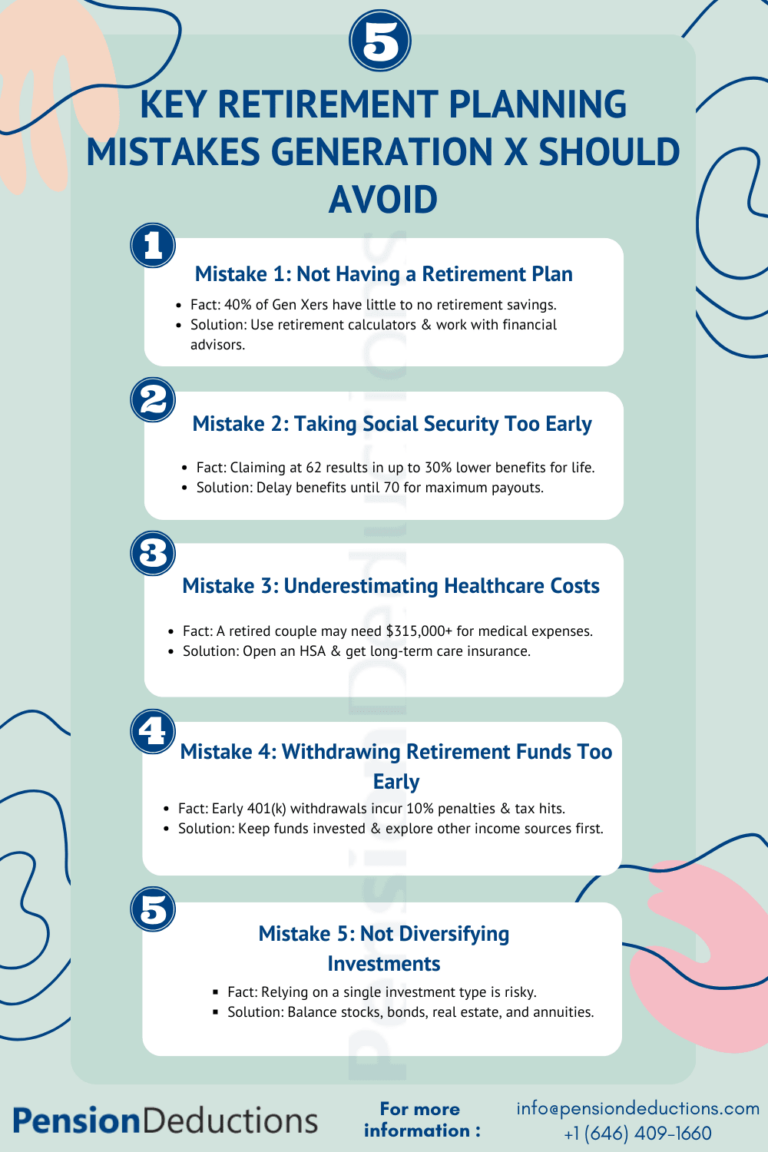
1. Not Having a Retirement Plan
Many Gen Xers assume Social Security will be enough, but without a clear financial strategy, savings may run out sooner than expected.
How to fix it:
• Use retirement calculators to estimate future expenses.
• Work with a financial advisor to create a detailed retirement plan.
How to fix it:
• Use retirement calculators to estimate future expenses.
• Work with a financial advisor to create a detailed retirement plan.
2. Taking Social Security Too Early
Claiming benefits at 62 leads to permanently reduced payouts, while waiting until 70 maximizes benefits.
How to fix it:
• Delay claiming Social Security for higher monthly checks.
• Consider working part-time to bridge the income gap.
How to fix it:
• Delay claiming Social Security for higher monthly checks.
• Consider working part-time to bridge the income gap.
3. Underestimating Healthcare Costs
Failing to budget for rising healthcare expenses can lead to financial stress in retirement.
How to fix it:
• Invest in long-term care insurance.
• Open a Health Savings Account (HSA) if eligible.
• Factor healthcare into your retirement savings goals.
How to fix it:
• Invest in long-term care insurance.
• Open a Health Savings Account (HSA) if eligible.
• Factor healthcare into your retirement savings goals.
4. Withdrawing from Retirement Savings Too Early
Some Gen Xers tap into their 401(k) plans too soon, incurring early withdrawal penalties and reducing their retirement nest egg.
How to fix it:
• Avoid early withdrawals unless absolutely necessary.
• Explore other income sources before using retirement funds.
How to fix it:
• Avoid early withdrawals unless absolutely necessary.
• Explore other income sources before using retirement funds.
5. Not Diversifying Investments
Relying on a single income source or investment type can be risky.
How to fix it:
• Diversify investments across stocks, bonds, real estate, and annuities.
• Rebalance portfolios regularly based on risk tolerance and market conditions.
How to fix it:
• Diversify investments across stocks, bonds, real estate, and annuities.
• Rebalance portfolios regularly based on risk tolerance and market conditions.
Final Thoughts: How Generation X Can Secure Their Retirement
The reality of Generation X and retirement is complex, but with strategic planning, financial discipline, and diversified income streams, a comfortable retirement is within reach.
By maximizing retirement contributions, reducing debt, delaying Social Security, investing wisely, and exploring alternative income sources, Gen Xers can take control of their financial future.
SHARE THIS POST
Related Blogs

cash balance plan
Defined Benefit Plan vs Cash Balance Plan: Which Is Right for You in 2026?
Read More »
Defined Benefit Plan vs Cash Balance Plan 2026 allow contributions of $100,000 to $300,000+ per year. Full 2026 comparison. Consult Now!
Shrideep Murthy
July 31, 2026
7:40 am

401k
How to Reduce Self-Employment Tax in 2026: 7 Legal Strategies That Work
Read More »
Just paid your April tax bill and felt sick? Here are 7 IRS-approved strategies to legally reduce your self-employment tax in 2026 — including one that can cut $50,000–$100,000+ off your bill. Q2 estimated taxes are due June 15.
Shrideep Murthy
May 5, 2026
9:15 pm

defined benefit plan
Am I Behind on Retirement Savings?
Read More »
Am I Behind on Retirement Savings? What Self-Employed Professionals Must Do Right Now | Pension Deductions Pension Deductions · Free Consultation · Call +1 (646)
Shrideep Murthy
April 9, 2026
10:47 pm

401(k)
Solo 401(k) vs. Defined Benefit Plan: Which Saves You More Tax?
Read More »
Solo 401(k) vs Defined Benefit Plan: Which Saves More Tax in 2026? | Pension Deductions Expert Pension Advisors · Free Consultation Available · Call +1
Shrideep Murthy
April 2, 2026
2:10 am